What's new
DiscussionHQ - General Discussions

DiscussionHQ is a general discussion forum that has opened December 2024!
We provide a laid back atmosphere and our members are down to earth. We have a ton of content and fresh stuff is constantly being added. We cover all sorts of topics, so there's bound to be something inside to pique your interest. We welcome anyone and everyone to register & become a member of our awesome community.

PV Window Box

I have already concluded that whole-house solar isn't practical for me here.

In the Summer I have to many leafed-out tall trees that shade most of my lot including my roof much of the day. Even areas that sunlight reaches directly part of the day end up shaded more than not. Winter is another story, offering even less power where sunlight reaches, and some of the large trees are evergreens so they remain obstacles. Not to mention we have more days of mostly cloudy and completely overcast in Winter.

Many who installed large-scale home solar power did so on the backs of tax credits which discounted the initial costs and selling power back into the grid to offset some of the operating costs such as maintenance and updates.

Solar panels need sweeping and washing and snow removal, not to mention cleaning out nests of wasps and crap left from Spring bird nesting. PV panels also degrade with time, becoming less efficient due to heat and aging and eventual surface erosion. Batteries don't last forever, though newer and more refined products are now good for as many as 4000 daily charge and discharge cycles before dropping to 80% of original capacity. Electronics (and there are a lot of electronic components orchestrating everything) can also fail.

Now...

It is becoming problematic getting credit for feeding your excess generated power out into the grid. Some power companies have long stopped accepting new backfeed applications, and have also begun charging grid transport fees on any outbound power.

In Europe this is beginning to get bad. Grid power fees are high and many had tried the "socially responsible" and economic path of whole-house PV. Changes such as grid-output transport fees are now making the payback time for a solar installation much longer. This appears to be driving some homeowners to stop sending power back into the grid. With the discouragement of coal, natural gas, and nuclear, the public grid has come to rely on capturing excess household solar though.

Austria wants to introduce a SOCIAL TARIFF for Electricity!

Her accent is a bit thick, so you might need to turn on closed captions for that video.
 
I now have my kitchen refrigerator completely time-shifted off the peak electricity rate hours here, and I even cover up to 6 off-peak hours with stored solar power. I also use solar to prefill the battery driving the fridge so that less grid power is used to recharge once peak rate time is over each day.

The next large load I'd like to eliminate peak-hours grid use for is my basement dehumidifier but the logistics are awkward if I want to supplement that with solar power. So instead I'll tackle something else first.

I'm finding that I am using my PC and dual monitors during peak billing hours. This burns from 130 to 165 watts depending on load and ambient temperature (and thus fan load). Small enough to be covered using one of my smaller powerstations, with no lugging "buckets" of captured solar power up and down stairs. I am close to doing this now.

And of course I am still powering interior lighting, small fans around the house, and keeping various things like my lawnmower, leaf blower, string trimmer, etc. charged and running.

None of this is paying for itself in peak rate savings or even solar-offset savings.

But... This is just a hobby activity. One that keeps my mind active, keeps me running outside, keeps me lifting weights and running cables, etc. It beats staring at the walls until I'm drooling on myself in a rest home. If I get a little return from the activity then it feels a little bit less frivolous.

Think of it like fishing or gardening or tapping trees to make maple syrup. 😜
 
Many powerstations above a certain size support remote access via Bluetooth and/or WiFi. Over time newer products are offering this down into the 0.5KWh range.

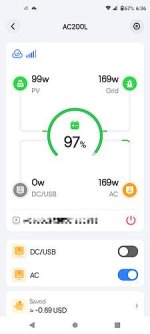
These phone apps offer monitoring, control, and can display usage statistics. Here is an example for my Big Guy, other manufacterers offer similar functionality.

Screenshot_20250722-063628.jpg
Here you can see the power flows and battery charge level. Here my refrigerator is taking 189 watts, passed through from the grid. In the meantime there are also 99 watts of solar power coming in and it is used to top off the battery. There are also options to prioritize PV input and feed it to the AC and/or DC loads in preference to the grid.

There are also charts of usage. inputs and outputs, giving hourly totals by day, month, or year. You can also remotely power the unit off when desired.
 
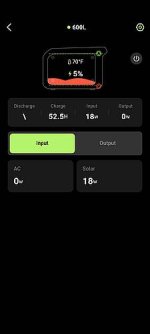
Here is a screenshot from another brand's app. It shows the "inputs" display, which is showing battery at 5% and 18 watts of solar input (the sunrise has not cleared the trees yet):

Screenshot_20250722-082310.jpg
This one also shows the temperature of the device.

It doesn't have the powerflow graphic of the other make, but all of the data is available in another form.
 
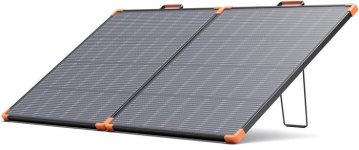
After spending time every day with this gear I have decided that the best portable solar array for me is the 180 watt N-Type 16 busbar panel I bought.

Very light, very good performer. Downsides: (1.) relatively fragile so for transporting these you really want the carrying case they come with, and (2.) they have fold-out "kickstands" but these do not support the panels at the steep angles you want near to sunrise and sunset.

I "fix" this by pounding in a prop-rod (green plastic-coated garden support rod) at an angle and leaning the array against it at a high angle. later on in the day I can just use the built-in kickstands.

Most powerstations in the mid-capacity ranges (500 to 1000 watt-hours) can accept up to 60 volts of PV input at 8 to 10 amps. These ZOUPW 180W model panels have 17 volt output, so I can wire two in series for those powerstations. Or I can use just one and use it with a smaller powerstation, most accept up to 25 volts so it's all good.

ZOUPW 180W 2.jpg

When I got started at this I bought a powerstation + solar array bundle deal. This 350 watt array puts out 33 volts, so it can't be used with smaller powerstations. It is also many times heavier, bulkier, and awkward to set up and take down, and performs quite poorly in comparison with a pair of the N-Type 180 watt arrays. There are also other issues, such as the delamination at the folds - which I am now seeing myself.
 
Last edited:
I've been checking things around the house, and small to medium fans I have use about 40 watts on high.

So even a smaller 280 watt-hour powerstation can run such a fan for 7 hours. Step up to something in the 550 watt-hour range and a full charge gets you two fans for 7 hours or runs one fan two days.

A lot of the USB-powered lamps I have can be run as low as 1 watt or less when dimmed down 2/3 of the way. So that hardly makes a blip in the fan run-time if you combine using the two things together.

A fan is no air conditioner, but it beats nothing in sweltering heat. My mid-sized box fan blows a nice breeze down on medium speed or even low, extending the run-time further.

So this is a practical use for power outages that you might really appreciate. You probably have flashlights and candles, but running a fan and recharging your phone can be welcome.


Keep in mind that you don't need any solar panels for this. These powertations can be precharged from the grid and recharged from the car cigarette lighter if need be. Many people will recharge from a small gasoline generator they already have, which can't safely be used indoors.
 
Last edited:
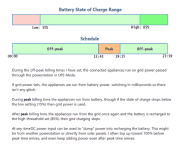
I am not running my refrigerator and my PC and monitors on powerstations in Timed Uninterruptable Power Supply Mode.

This is normally just a pass-through of grid power to the appliances, but during my peak electricity billing interval of 2 PM to 7 PM (plus a little on each side for comfort) everything runs off battery power.

If grid power goes out then battery gets used instead.

I can also connect solar panels to recharge the battery, or "dump" in power that I harvested using smaller powerstation devices with solar panels.

Timed UPS Settings.png
Not shown there, I also often plug the refrigerator into the Beige Bomb for 6 to 8 hours, taking it completely off-grid for that time. If I have the extra stored solar power I want to use it up somewhere. Saving even off-peak fridge consumption of grid power is worthwhile.

That operation is manual, moving a fridge plug. But the rest (above) is completely automatic.
 
One thing for sure, keeping at this hobby on a daily basis is getting me outdoors and more in tune with weather and the daily cycle than before! It really is a lot like gardening or keeping chickens or something.

August 4th, and I am already very conscious of the shortening days. In addition I am very conscious of how quickly the sun "moves South" as morning progresses and we move toward the Autumnal Equinox, September 22 this year.

3-s2.0-B9780128121498000028-f02-02-9780128121498.jpg

I struggle a little keeping at this. Mostly as evening approaches and I need to bring stuff in. This is usually the hottest part of the day and I'm also feeling more physically tired. However, most mornings I feel good about it and it makes me get up and get going for the day.

My situation is a little weird. First, I have to keep going out and moving things to chase the sun since I have so much shade to dodge. I also ended up with a lot of solar panels to fiddle with as I learned more and acquired better ones - but being a cheapskate, I make myself use most of them! :ROFLMAO:
 
Oh, by the way:

While those dinky fold-out "notebook" solar panel arrays (20, 40, 60 watts) do indeed work, they aren't really worth much. Keep in mind that most panels are only going to return maybe 60% of rated ideal converted power even under your best conditions and positing at the sun.

Those in the 100 watt range are more practical, but only for smaller powerstations or charging up a phone (many of these include some sort of small solar charging controller with USB output).

I have two of those, and I seldom bother using them except to wire the two in parallel (they are very similar in voltage) to charge powerstations with around 450 to 500 Wh of battery. Even then, my short "solar day" here means they only deliver enough power for half a charge.
 
Here's a guy describing how to power your house in an emergency. Relatively small scale, no special wiring, no electricians, no rat's nest of permits.

He uses a bigger powerstation than I have, but you could also use a couple of smaller ones to do the same thing. He uses a gasoline/propane dual-fuel generator to back up the powerstation (i.e. recharge it).

That gets the combustion away from the house.

 
Some down-home advice on solar batteries and fire. Don't consider this authoritative or definitive, but it is a good overview that isn't off-base.

Different battery chemistries and topologies have different requirements and risks. Proper usage is important as well. The issues and differences can seem subtle at first.

Fortunately most modern prepackaged "solar generators" (i.e. power stations) of any real capacity and quality have moved to safer types of cells as well as battery management systems with more safeguards. However it never hurts to check and verify. Your family's life might depend on it.

 
With Summer's end comes Sun angle woes again, and even here at the end of August things are getting tight. Solar power collection is becoming dicey, though I have an excellent "keyhole" yet between about 8:30 AM and Noon. After that shade pretty much wipes out my chances.

Perhaps once the leaves all drop it'll be another matter, but at the same time by then it'll be nearly Winter with shorter days and far lower Sun angles.

Today I may try another strategy. I have one 1K Wh "draggable weight" powerstation that can accept 60 volts of solar input and a maximum of 600 watts in. Yesterday I saw a peak in full sunshine at a hair over 400 watts of input on two arrays in series. I'm going to try 3 of my 17 volt arrays in series, hoping the battery fills up quickly. After that I can split the 3 up for use with lower-voltage powerstations. This way maybe I can optimize use of the few good hours I'm getting.

One thing that's changed is a lack of wildfire smoke overhead. The difference is measurable, and yesterday a configuration that worked for most of the Summer did not yesterday. As far as I can tell the Beige Bomb powerstation was seeing a voltage level over its solar controller's limit. Rewiring for a lower voltage worked, so at least I didn't burn anything out.
 
Well the Beige Bomb continues to be a trooper. While inelegant in several ways, it powers the 'fridge for 8 hours every night.

This morning I figured out an issue though. Some mornings it refuses solar charging, indicating over-voltage from what I can decode on its display.

It has no problem accepting power from two 17 volt arrays in series. Yet sometimes it will balk at a 33 and a 17 in series. It has a 50 volt solar charge controller, so it seems to be on the edge that way. The variable seems to be which cable I use.

My slightly longer 12 gauge cable works fine. My slightly shorter (a few feet) 10 gauge (heavier) cable fails. There must be just enough of a voltage drop in the thinner cable's resistance to bring things down into a range the Bomb can handle.
 
Whew. The sunlight angle and patches of ground with direct light sure move rapidly now. I have to move panels around twice as frequently as in Midsummer days.

I'm still strategizing for the coming Winter. Leafdrop will open possibilities, but snow on the ground will make dragging stuff around much less practical. I'm thinking about a Southerly exposure where I can hang a few panels above snow level and leave them semi-permanently, accepting what power I can get. But I already know that means capturing less than 10% of what I am getting even now.
 
With the change of season I'm nearly back to "window box" scale solar power capture again.

I can almost squeeze an hour yet in the back yard from about 9:00-10:00 AM. Then another area opens up from about 1:00-2:30 PM. Finally my South side yard opens up for almost two hours from 2:30-4:30 PM. But these continue to narrow.

That's pretty meager and requires a lot more moving of panels and cables and power stations than during the Summer. And my net capture of power is maybe 1/4 of what I achieved in Summer.

While I'm dealing with raking up leaves already and that's ramping up, the trees blocking most of the sunlight haven't really dropped significant amounts yet. In fact they cast more shadow than before, thus my more limited sunlight available for capture.

I'll have to watch the changes as Autumn progresses.
 
This guy seems like one of the more honest and thorough reviewers out there:


This is unique because it uses sodium-ion cells instead of some sort of lithium-based chemistry.

This new product is probably more of a trial balloon than really practical. Sodium-ion has two major drawbacks: bulk and weight. So it doesn't seem practical for portable power, EV cars, etc.

But with recent refinements to take advantage of... its advantages better there are some possibilities raised by creating commercially viable finished products.

I suspect its primary niche will be stationary batteries, either grid backup or in-home "powerwall" batteries. These can help level out power demand peaks, capture solar and wind for later "playback" when there is no wind and sun, conventional power generation, etc.

But another could be in the electrification of heavy vehicles. For example semi tractors and construction equipment. Faster charging, high-volume discharging, and wide operating temperature range would all make a difference over lithium technologies.

We'll see. Even now it still has a long way to go.
 
Now that I'm well into Autumn things have changed even further. Different "keyholes" open up at these Sun angles and they open suddenly, move quickly, and close abruptly too. Entirely different spots on my small property get sunlight now, for shorter periods, and far less intense.

All of this is as expected, but the change came on more quickly than I'd expected in my bones.

I'm now only capturing about 1/3 of the power I was gathering in the Summer months. But then, my grid electricity billing rates are now at off-peak 24 by 7 so I don't need solar power as much... but of course that ignores the reality that I use more power in cooler and darker months.

It still does help that I'm relying on interior lighting that is smaller-scale, powered from small powerstations or internal batteries recharged from those powerstations, and much of it triggered by built-in motion detectors. Other lighting can be switched on/off and brightness levels set via Alexa voice commands. So instead of lighting burning power all the time, it either comes on then turns off as I move through rooms or can be triggered without running for wall switches to do so. If a task needs more light raising brightness is just a spoken command away.
 
Interesting solar-adjacent product:

A battery pack that can be solar-charged, designed to clip-on and power a StarLink Mini satellite Internet dish/WiFi-router combo.


The StarLink device and service is a way to get Internet access, portably or out in the boonies. You could even use it for rural Internet at home. The battery pack add-on product could extend the range of applications as described in the video.
 
Slightly off the main track here, but...

My solar-powered under-hedge lighting and Christmas lights are looking great. I've been getting enough daylight so they run for several hours after dark.

I'm really enjoying the salvaged/repurposed "worn out" under-hedge lights that I replaced earlier in the year. These are up under the garage's back roof eaves and provide nice patio lighting out there whenever I've had an hour of sunlight or two to supplement what gets through the clouds.

Aside from changing out the colored light strings for various occasions, these are zero-effort solutions. Nice items to consider when they go on sale.
 
We use solar light strings, too, but mostly as summer decorations in the yard, and not for holiday colored lights like you have, @Jacob Petersheim . I think that the colored lights is a great idea, and we probably get enough sunshine most days that they would light up for at least a little while.
 

Users who are viewing this thread

Back
Top