
What's new
DiscussionHQ - General Discussions

DiscussionHQ is a general discussion forum that has opened December 2024!
We provide a laid back atmosphere and our members are down to earth. We have a ton of content and fresh stuff is constantly being added. We cover all sorts of topics, so there's bound to be something inside to pique your interest. We welcome anyone and everyone to register & become a member of our awesome community.

Metals, a Hedge or Investment Depending on Your Views... or a Sucker's Bet?

Jacob Petersheim

Well-known member
Joined
Feb 27, 2025
Messages
1,645
Location
Michigan
Things appear to be getting weird in banking and in precious metal prices. It is hard to predict the future of banking independent of a digital currency, or even the security of existing deposits. Gold has been going crazy, and silver is now rising. This despite a lot of people desperate for cash dumping so much on dealers that they and their wholesalers have a hard time accepting it all.

So what's up?

Do you "stack" Constitutional 90%-silver coinage for possible barter use if things get bad? Do you have a sack of silver Eagles, or some gold?

Is this all far too expensive and prices out of our control for us to really hold enough metals to matter? Is it a scam to lure in the gullible, profiting off dealer "premiums" on purchases and discounts on sale?


Most people can't afford to "stack gold", but silver is much more affordable. Precious and non-precious metals are simply a hedge against inflation. The Federal Reserve has a target of 2% or 2.5% inflation every year. That essentially means they are stealing 2% of your wealth every year, mostly to supplement the wealth of those already in the top 1% of the elite. The Fed was founded to make a few people very rich , and was designed according to some to only last a century or so before collapsing. It was sold to the American people as a way to prevent depressions, but the establishment was followed a little over a decade later by one of the worst depressions in history...the Fed doesn't work.

Anyway, metals, real estate and a few other hard assets are simply ways to prevent the Fed from stealing your money, nothing more. There can certainly be scams involved, but if you buy from a reputable agent or dealer, there is little to no risk involved and lots of benefits. The only downside is that you have to be able to spend your wealth and it would be difficult to impossible to buy a week's groceries with gold coins or bullion. Many pawn shops and metals dealers will convert your assets back into currency, but it takes time and isn't always convenient. Real estate is even harder to convert back to currency as usually significant sums are involved.
 
Real estate is even harder to convert back to currency as usually significant sums are involved.
That's a good point.

Maybe real estate is for those the next level up in wealth, with metals for those below that.

In the videos I linked the guy seems to be making the point that silver and gold are fundamentally and practically different though. Gold for long-term wealth preservation but silver can be an investment of a sort and traded.

Gold seems expensive, true, but a 1 oz coin goes for less than 1/10th of a new car at today's prices. So high enough, for sure, but not out of range for a lot of people.
 
There are trends to be concerned about.

Globalization (1.0) exported jobs to low-wage labor. Globalization 2.0 imports low-wage labor to take remaining jobs.

The "masters" of these machinations want to use consumers' savings to accomplish the goals of Globalization 2.0 by providing incentives to turn away from saving to "infrastructure" investing.

BlackRock Wants YOUR Savings! Here's How They'll Take It

This is probably why interest rates are already falling within the EU, UK, and Canada. While rates might (might) be too high in the US, we might want to be careful not to wish for a substantial reduction in those rates. If your savings can't get 4 or 3.5 or even 2.5% you might be incentivized to move the funds into stocks of dubious net effect with nefarious intended purposes. Keep in mind that "infrastructure" probably means "Green New Deal 2.0" or something else of a similarly dubious nature.

So when they start to beat up savers, metals might be a possible escape. Assuming that hasn't been capped first, through revaluation and rapidly escalating prices rendering it impractical.
 
I'm just guessing, but I'm getting the idea that most of us can't afford to dabble in such things and the rest are too smart to talk about it online. :ROFLMAO: I had the impression that your "gold bugs" love the topic and cannot resist talking about it and giving their opinions.

Most of us probably aren't investing in significant real estate either. It seems like few even maintain a second home, something I've never really imagined myself. Not even a small getaway cabin or isolated plot with a trailer on it.

Perhaps most of us are just down to Earth types from working class backgrounds, managing well enough to get by and maybe help our kids a little.
 
Many of my friends have getaway cabins. I have toyed with the idea myself but never acted on it. One of my wealthier friends that I have mentioned in the past has three homes--one out here, one in Anchorage, and one on Maui. Another guy has a home here, one in Nevada, one in Mexico and one elsewhere that I can't remember where. The latter guy made a killing on his house in Anchorage that he bought many years ago. He sold it for $4 million or so and reinvested that money in other real estate. The guy with three houses has land everywhere. Whenever he has spare cash, he buys a lot , usually empty, somewhere if the price he can get is good.
 
I've looked into it, and there are some strange things about it.

To buy metals you pay a "premium" which is covering the costs and profit of the store. Sell it back and often they won't offer "spot" price, but below that. I guess they want to cover expenses and profit a second time.

I can see all that, but... so much for it being "real money." It is a commodity.
 
It is hard to know what do do about preparing for an economy crash. Whether you have precious metals, or items to trade, you are apt to be killed by someone stealing them if they know you have something of value, even (and maybe especially) food items.
Any of them would work for barter probably , but once no one who gets government checks is receiving them, or banks collapse; it will be out and out looting for anything.
Probably they will first raid stores and steal worthless stuff (like iPads and televisions,laptops, etc), but once they realize those might not work again, people will be looting for things they can actually use.

Having a place off-grid might work, but not for many of us who are older, and not capable of living that way anymore, or even for younger people who have simply never done any of that in their life.
I do think that President Trump is trying to move us towards a gold/silver based money system, but we might have to go through a crash to get there.
 
Well, right now there are many things moving around in the "moneysphere."

National deficits and sovereign debt, the Fed and interest rates, de-dollarization and BRICS, gold shooting up, silver wobbling upward, the global trade picture changing.... not to mention Social Security woes with accelerated Trust Fund depletion in the wake of Biden's "Fairness Act" windfall to Federal and California (and a few other States') public employee retirees.

Just lately I hear serious people talking about "gold revaluation" as a partial cure for the debt. What that really means is "Dollar devaluation" via this mechanism. Shrink that Dollar, debt in Dollars shrinks - as long as you have non-Dollar wealth in gold to sell... or "rent" through bonds and certificates and other such financial bookkeeping tricks. Then you have the crazy cryptocurrency stuff, possible Central Bank Digital Currency future, and on and on.


Say you have one ounce of gold at a current price around $3500. If gold is "revalued" at $15,000 per ounce (yes, I am hearing this) "tomorrow's" the Dollar falls to 23.3 cents of "today's" Dollar's buying power.

If all of your money is in Dollar-denominated assets (cash in the mattress, savings, CDs, money markets, and on and on)... oops! That goes for your pay or Social Security checks as well.

So the jabber is that gold (and to a different degree silver) is not really a practical "investment" but more of an "inflation hedge" or place to park money against future need.


Liquidity (he lack thereof) is the downside. You can't pay that utility bill in gold or buy groceries with silver at anything close to spot (current market) prices, nor accomplish that frictionlessly. You still have to convert it back to Dollars through a willing buyer.
 
In a full SHTF scenario I'm not sure about gold. As you say, it seems to carry risks of theft and/or violence. And trying to use it seems problematic.


In a less dire breakdown silver, in the form of Constitutional Silver (mainly 90% silver coins minted before the 1960s) might be barterable.

Those are the old silver dimes, quarters, half-dollars, and dollar coins. Because they tend to be munged up by circulation and are not fine silver (10% other metals, which made them more durable) this is often called "junk silver" by dealers.

These have dates, appearances, weights, and "ping" when struck which all taken together makes them more practical "trade tokens." Especially considering they are smaller and more readily "spent" than a 5 ounce bar of silver.

Yes, you can still buy them by the coin roll or by the sack from metals dealers. But more of them do get melted down every day. Especially recently when people hoarding them started selling fast when silver rose in spot price. Dealers suddenly had a glut of them and turned them over to wholesalers for melt.
 
I'm now hearing about this "StableCoin" concept.

One version would have gold backing. You'd buy into it with Dollars, and can make payments in Dollars from your balances electronically. Much like a checking account, PayPal, etc. Unlike bank accounts, you never earn interest. However pulling value out in Dollars offers some protection from inflation and money-printing.

You would not have physical gold in your possession, it would be held by a trustee organization "playing banker." As the Dollar shrinks in buying power, your SC balance increases (in Dollars at that point in time) based on presumptions that gold in Dollars would rise. Of course other gold price fluctuations impact your balances' value as well.

Other versions do things like avoid gold and hold Dollars instead. But I don't see the reasons for doing this. It sounds like bank accounts that earn no interest on your balances. I need to hear more about the idea, there must be something I am missing.
 
Of course there are "respected" voices right now suggesting a very different near-term future in the US. One involves a requirement to "vault" your gold with an approved custodial bank (or something). The only goal I can imagine in this might be to "allow citizens to own gold" but in reality merely give them only paper and digital "gold." I wonder if once people have turned in their gold all future purchases will take place via these "custodians?"

Such paper gold already exists privately, in the form of gold ETFs nd other paper gold instruments. I'm suspicious of gold mining stocks myself.
 
The US "Constitutional Silver" (dimes, quarters, halves, and dollars) minted prior to the mid-1960s are basically 90% silver and 10% copper (for hardness and wear). This "junk silver" isn't particularly collectible, doesn't qualify as silver bullion (99.9% silver).

However it is still considered worth having because (a.) it is cheap to obtain, (b) some of the old designs are still of casual interest historically and nostalgically, and (c.) can be used for barter especially if things ever got bad as when currency becomes debased or untrusted.

I got curious about some numbers.

It takes nearly 14 of these dimes to add up to 1 Troy ounce of silver (barring wear, and a lot of the old coins sure do have wear).

Metals dealers often sell these by the $10 face value roll and $100 face value sack on up to $100 sacks and beyond.

So a $100 sack of silver US dimes has 1000 dimes. Right now these are selling for around $2750. This sack of dimes has about 72 Troy ounces of silver in it.


There were also some Eisenhower Dollars (Apollo 11 on the reverse) minted in the first half of the 1970s. Some of these are 40% silver (for collectors), but most of these (nearly all) are cupronickel clad. They didn't see much circulation. People had fallen out of the habit of carrying and using larger coins. Later dollar coins were far smaller in size.
 
Trivia:

A pound of gold is 12 troy ounces, not 16. This is because gold is measured using the troy weight system, where a pound is defined as 12 ounces, while the common "avoirdupois" pound used for most other goods contains 16 ounces.

Somehow I never knew this, or I have completely forgotten about it.

Even coins and "rounds" struck in metals like copper are made/weighed in avoirdupois weights, unlike gold, silver, platinum, etc. in troy units instead.
 
BTW:

Copper bullion can be a cheap way to get into "stacking" metals. It has some problems though.

It takes an awful lot of it to be worth anything at all. It is not a precious metal, and so few (if any) government mints issue standard coins or "rounds" in copper.

Fine copper (0.999% or better) can quickly tarnish and corrode, Humidity and even sunlight can result in uneven tarnishing, making it even worse, It doesn't take long for the shine to leave the surfaces, and this is a soft metal that readily picks up dings and scratches.

"Copper" coins used historically were really alloys such as formulations in brass. This slowed corrosion and deterred wear from use significantly. Most of us remember how shiny new pennies used to be and how quickly the pinky-gold color changed to dull browns, sometimes nearly black. Some even acquired spots of green sulfur compounds.

I'm reading that storing copper near other metals can also accelerate tarnish. Maybe that's why pennies go brown so fast? Perhaps this is some sort of electrolytic or catalytic process.
 
One of the “big things” now is copper drinking mugs, which is supposed to help purify whatever you are drinking because the copper is antimicrobial (if i am remembering the advertising correctly). Those mugs look like they always stay shiny and copper looking; so they must be a mix of copper and something else that helps them keep the color and shine.
I remember that when I had the stainless steel cookware with the copper bottom, all it took was some vinegar and salt, and they were shiny in seconds.

Back when I worked for Combined Insurance, they always were having special promotion weeks for the sales people, and often one of the prizes would be an ounce silver coin. I had a whole stack of them, including one with an image of W.Clement Stone on it. I think that my daughter has all of those now. I gave some to all of my kids, but i don’t think that either of the boys kept theirs.

Saving the older coins is a good idea, because (unlike paper money) they should always have some value. I have been reading that it cost several cents to make a penny, so they are planning on not making them anymore before too long; so saving them is a good idea, even if the copper is not worth much.
 
It has been a while since I handled one, but the old Silver Dollar is 39.1mm (1.5 inches) in diameter. Morgan, Peace, and Eisenhower Dollars are the same diameter.

The US Mint 1 ounce Silver Eagle is 40.6mm (1.598 inches). The Canadian 1 ounce Silver Maple Leaf is 38mm in diameter.
 
One of the “big things” now is copper drinking mugs, which is supposed to help purify whatever you are drinking because the copper is antimicrobial (if i am remembering the advertising correctly). Those mugs look like they always stay shiny and copper looking; so they must be a mix of copper and something else that helps them keep the color and shine.
I believe an exposed copper surface has antibacterial properties, and copper drinking water piping got some benefit from this even though with time the inner surface limed up.

Up North in the Keweenaw and on Isle Royale we have our Copper Country. Notable for native copper nuggets of very high purity, and often occurring along with veins of silver.

Massive amounts of copper were taken out, and one huge nugget boulder was spirited away to The Smithsonian. Prehistorically U.P. native copper was worked and traded by the Indians since no smelting was required. However more appears to be missing than can be accounted for by conventional history. Large surface mining pits still dot the Island. Supposedly many "Old World" artifacts on copper, brass, and bronze have been isotope-analyzed and show that very significant amounts of U.P. copper "somehow" ended up throughout Eurasia.

I have two souvenirs of the area, one is a small polished slab of Malachite (a green rock) with heavy veins of native copper. Another probably isn't actually U.P. copper: a heavy copper curb-link chain necklace I bought up there. But though I've found that stone sample, where I stashed the copper chain eludes me! I am positive that it is here though.

While very shiny when new, that chain oxidized to duller brown VERY quickly. My guess is that those mugs you mention are either coated or varnished or else they are made of some alloy as you suggest.

The raw metal looks just the way new pennies used to look, a bit pinkish. Anything yellower than that is likely an alloy.
 
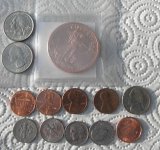
Here are a few random coins along with a 1 ounce (ADVP) 0.999 fine "mint fresh" copper bullion medallion round (a Walking Liberty design). The copper round is tough to see here since it is in a polypro "flip" case within a heat-sealed bag for protection, but the color at least does come through.

Coins.jpg

It's a little paler and pinker than even the fairly new-condition pennies in the rows below it.

It is 39.3mm in diameter. The stamping isn't as detailed or in as high-relief as silver and gold would normally be minted. This is an economical form to produce down to a minimum cost over the bulk metal.

These retail for about $1.50 to $2.50 right now. They scratch and pick up fingerprints quickly, and likely age to brown at least as quickly as a penny.
 

Users who are viewing this thread

Back
Top